
Sound Wall Isolation: Stop the Flanking Noise
A sound-rated wall is only as good as the path around it. You can specify two layers of 5/8” Type X, fill the cavity with mineral wool, seal every joint, and still fail a field test if vibration walks straight through the top and bottom plates into the surrounding structure. That bypass is called flanking, and it is the single most common reason a wall that tested at STC 53 in the lab comes back at FSTC 47 on the jobsite.
Stud wall isolation products exist to close that vibration gap. Even when walls, ceilings, and floors are designed for acoustic performance, structure-borne vibration can bypass those assemblies through direct connections to the building structure. This guide looks at the Kinetics Wallmat system, explains where flanking comes from, and gives you the reference tables to spec, estimate, and verify a sound-rated assembly with confidence.
What Wallmat Stud Wall Isolation Actually Does
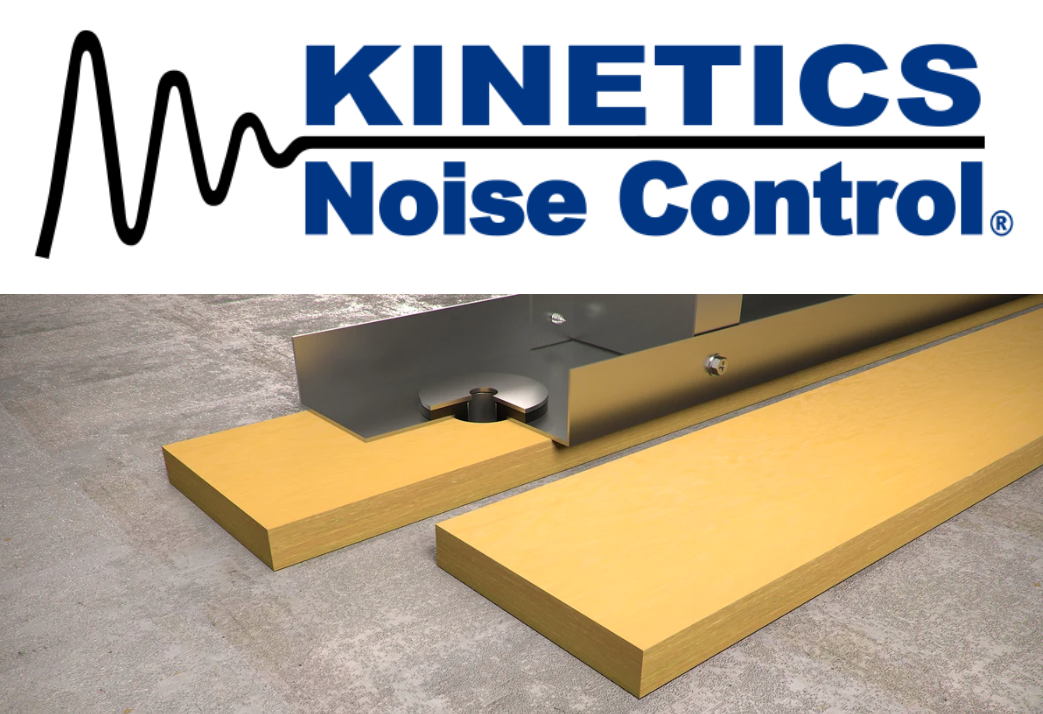
Kinetics Wallmat is a molded fiberglass mat that resiliently decouples a sound-rated wall from the structure it sits on. You run it continuously along the bottom and top plates of a stud wall wherever acoustic isolation is required. Instead of the framing sitting hard against the slab above and below, it rests on a resilient break that absorbs vibration before it can transfer.
The mat alone is half the system. The other half is the KAI anchor isolator, a rubber bushing assembly used at each fastener point through the top and bottom plates. Without isolated anchors, every screw or bolt is a rigid short circuit that reconnects the wall to the structure and erases the benefit of the mat. KAI bushings keep the fasteners decoupled so the separation stays 100% resilient.
Together, Wallmat and KAI create a vibration break that stops sound and structure-borne energy from flanking around the rated assembly. It is frequently paired with other isolation products on the floor-ceiling side of the same project.
Wallmat Specifications at a Glance
Material: Molded fiberglass mat using Kinetics KIP Isolator technology
Length: 48” pre-cut mats
Standard widths: 3” and 5”
Custom widths: Available per project loads
Wet area option: Optional coating for wet installations
Placement: Continuous under top AND bottom plates
Anchors: KAI rubber bushing isolators at each fastener
Load range: Engineered for a wide range of stud wall loads
Fire rating: Can be used in UL rated assemblies
The 48” pre-cut format matters for production. It lines up with standard plate runs and keeps install fast, which protects your labor budget on a system that is otherwise easy to value-engineer out and regret later.
Why Flanking Wrecks Sound-Rated Walls
Sound moves two ways through a partition. The airborne path runs through the drywall, into the cavity, and out the other face. The structure-borne path runs through the studs, plates, and connections as vibration. Real projects always combine both.
STC and IIC ratings published by manufacturers are lab numbers, measured under ASTM E90 (airborne) and ASTM E492 (impact) in a controlled chamber with no flanking. The field is not a lab. When you install that same assembly, flanking through the slab, the deck, back-to-back outlets, and unsealed penetrations pulls the real performance down.
The penalty is not small. A one-inch square hole in a 100 sq ft STC 50 wall can drop it to STC 39. Flanking through a floor-ceiling assembly can cut STC or IIC by 10 points or more versus a properly broken assembly. Field measured ratings typically run 3 to 7 points below the lab rating, and a wall rated STC 53 in the lab can measure FSTC 47 to 49 installed.
Where Sound Flanks Around a Rated Wall
Rigid top and bottom plate contact - Impact: Up to 10+ STC/IIC points - Fix: Wallmat + KAI isolators
Back-to-back electrical outlets - Impact: Several points; can leak 10 to 20 dB - Fix: Separate stud cavities, putty pads, acoustical caulk
Unsealed perimeter and joints - Impact: 3 to 5+ points - Fix: Continuous acoustical sealant
Short-circuited resilient channel - Impact: Defeats the channel entirely - Fix: Never screw into studs or hard backing behind RC
MEP and plumbing penetrations - Impact: Several points - Fix: Firestop, acoustic seal, pipe wrap
Slab and deck transfer - Impact: 10+ points on floor-ceiling - Fix: Isolated slab, sound mat, resilient clips
What the Code Actually Requires
If you build Group R occupancies, this is not optional. The International Building Code ()IBC Section 1206 sets the airborne minimum at STC 50 between dwelling or sleeping units and adjacent units, corridors, or service areas, tested under ASTM E90, or a field rating of NNIC 45. Section 1206 and 1207 sets the impact minimum at IIC 50, or AIIC and FIIC 45 if field tested.
California adopts these through the California Building Code with the same STC 50 and IIC 50 baseline. In the City of Los Angeles, LAMC Section 91.1206 carries the same numbers and lets the Building Official require field testing whenever sound leaks or flanking paths are evident or the assembly was not built per the approved design. Read that last part carefully: the inspector can call a field test specifically because flanking is visible. Stud wall isolation is how you keep that test from becoming a tear-out.
Code Minimums and Field Allowances
IBC 1206 and 1207 - Airborne (STC): 50 lab - Impact (IIC): 50 lab - Field allowance: 45 field (NNIC and AIIC)
California CBC - Airborne (STC): 50 lab - Impact (IIC): 50 lab - Field allowance: 45 field
LA Municipal Code 91.1206 - Airborne (STC): 50 lab - Impact (IIC): 50 lab - Field allowance: 45 field (NIC and FIIC)
ICC G2 Acceptable (Grade B) - Airborne (STC): 55 - Impact (IIC): 55 - Guideline, not mandate
ICC G2 Preferred (Grade A) - Airborne (STC): 60 - Impact (IIC): 60 - Guideline, not mandate
Why STC 50 Is a Floor, Not a Target
STC 50 is the legal minimum. It is rarely the right design number. Because field results run 3 to 7 points below lab, designing to exactly 50 means you are gambling that workmanship and flanking cost you nothing. They always cost something.
The industry rule of thumb is to specify STC 55 to 60 so the field penalty still lands you above 50 on testing day. ICC G2 backs this up, calling STC 55 Acceptable and STC 60 Preferred. For luxury multifamily, hospitality, and hard-floor projects in markets like Los Angeles, Orange County, and San Diego, owners increasingly expect 55+ to avoid tenant complaints.
What Each STC Level Means to an Occupant
STC 30 to 35 - Normal speech clearly understood through wall
STC 40 to 45 - Loud speech faintly audible; moderate privacy
STC 50 - Loud speech barely audible; code minimum
STC 55 - Loud speech reduced to a murmur; recommended target
STC 60+ - Speech effectively inaudible; theaters, studios, hospitals
Each 10-point STC increase roughly halves the sound energy passing through the wall. The jump from 50 to 60 is the difference between hearing muffled music and hearing nothing.
Typical Assembly STC Values
Use this to sanity check a spec before you bid it. These are approximate lab ranges for common configurations. Decoupling and mass drive the number; adding drywall layers alone gives diminishing returns.
Single metal stud row, one layer 5/8” each side, no insulation - Approx. STC: 33 to 38
Single stud, one layer each side, cavity insulation - Approx. STC: 40 to 45
Single stud, two layers one side, insulation - Approx. STC: 45 to 50
Staggered stud or resilient channel, insulation - Approx. STC: 50 to 55
Double stud row, single layer each side, insulation - Approx. STC: 52 to 55
Double stud with double layer and decoupling - Approx. STC: 60+
A few field-proven levers worth knowing: cavity insulation adds roughly 5 to 10 STC points. A second layer of 5/8” adds about 4 to 6. Switching from 20-gauge to 25-gauge studs can add 4 to 7 points because lighter studs flex and transfer less vibration. None of those gains survive if the wall is rigidly flanked at the plates, which is exactly the failure stud wall isolation prevents.
The Estimating Angle: Don’t Lose the Isolation Line Item
Here is where this gets practical for drywall and framing subs. Acoustic isolation is a high-value, low-visibility scope. It is easy to miss on takeoff because it lives in a wall section detail or an acoustical spec section rather than the floor plan, and it is easy to underbid because the linear footage of top and bottom plate isolation plus a per-fastener anchor count is tedious to quantify by hand.
That is the exact problem accurate digital takeoff solves. When you measure isolated wall runs as linear quantities directly off the PDF set, tag the rated walls by type, and carry the KAI anchor count per plate, the isolation scope stops being a forgotten allowance and becomes a defensible line item. On a 48” pre-cut mat system, your material count is simply isolated linear feet divided by mat coverage, plus anchors at your fastener spacing. Clean takeoff turns that into a thirty-second calculation instead of a guess.
The cost of getting it wrong runs both directions. Bid it short and you eat the material on a change. Skip the field-test risk and a failed FSTC test can mean opening finished walls. Either one dwarfs the price of the isolation itself.
Installation Notes That Protect the Rating
Run Wallmat continuously. A gap in the mat is a flanking path. Treat it like a fire-rated joint, not a casual underlayment.
Use KAI anchors at every fastener through isolated plates. One rigid screw can short-circuit a full wall run.
Isolate both plates. Top plate isolation matters as much as the bottom; sound flanks through the deck above just as readily.
Keep outlets out of back-to-back cavities, seal them with putty pads and acoustical caulk.
Caulk the full perimeter with acoustical sealant before close-up.
This is the cheapest STC you will ever buy. Verify before drywall closes. Walk the isolation is intact while it is still accessible.
Bottom Line
Stud wall isolation is not an upgrade, it is insurance on every dollar you already spent on a rated wall. Mass and sealing get you most of the way, but if the framing is rigidly tied to the structure, vibration flanks around all of it. Wallmat plus KAI anchors give the assembly a continuous resilient break at the plates so the wall performs in the field close to how it performed in the lab.
Spec above code, isolate both plates, anchor with isolators, seal everything, and quantify the scope accurately so it survives the bid. That sequence is the difference between a wall that passes its field test and one that gets opened back up.
FAQ: Kinetics Wallmat
What is Kinetics Wallmat? A molded fiberglass isolation mat (48″ pre-cut, 3″ and 5″ standard widths) run continuously under the top and bottom plates of a sound-rated stud wall to break the structure-borne vibration path.
Do I need KAI anchors with Wallmat? Yes. Every fastener through an isolated plate needs a KAI rubber bushing isolator, one rigid screw short-circuits the entire resilient break.
What STC does code require? IBC 1206/1207 and the CBC require STC 50 and IIC 50 (lab) between dwelling units, with a 45 field allowance. Spec 55-60 so the typical 3-7 point field penalty still lands you above 50.
How much does flanking cost you? Rigid plate contact can strip 10+ STC/IIC points; a one-inch-square hole can drop an STC 50 wall to 39. Isolation, sealing, and workmanship are where lab ratings survive the field.
Keep reading
How to do a construction takeoff on iPad
The Numbers in the Wall
Wall Guide: Code, Fire and Sound Control
Dimecraft built for iPad construction takeoff and estimating tools for the construction pros - GC’s, Subs, CM’s, Architects, and Engineers. Measure and perform quantity takeoff for walls (linear), count (ea) , and area (sqft). Draw your takeoff and Dimecraft will quantify item totals directly off your PDF set so the high-value scopes never fall through the cracks. Dimecraft helps AEC pros manage projects from pre-con to punch-walk. Markup, annotate, review, qualify, takeoff, draw, draft, and manage your projects as they move from invite to build out.