
The Canvas Drywall Robot: What It Does, and What It Does Not
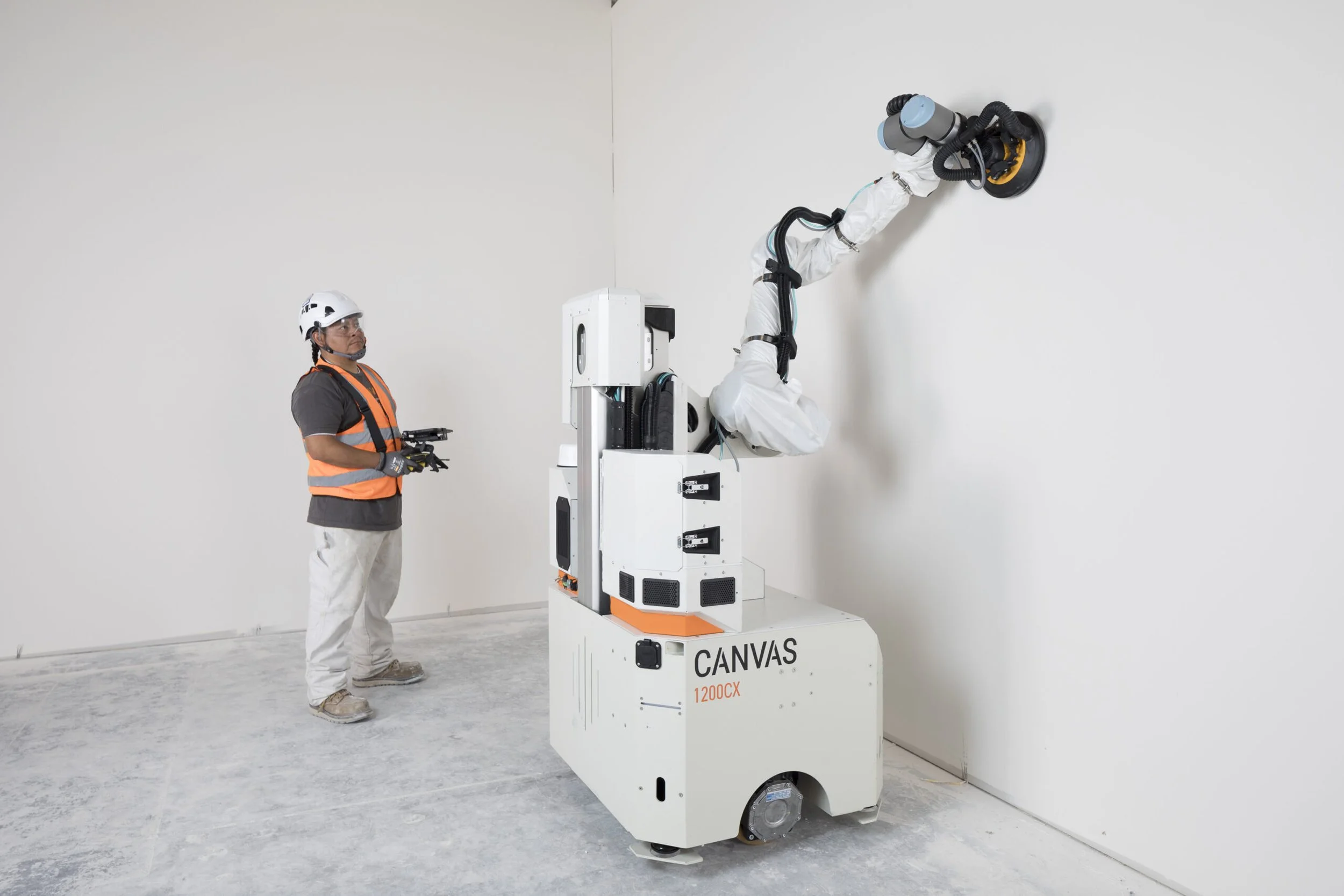
The Canvas drywall robot is gaining attention across the construction industry as a practical response to one of the most labor intensive and schedule sensitive scopes on interior projects. Drywall finishing has long depended on skilled labor, repetitive manual work, and tight sequencing with other trades. Canvas is applying robotics and automation to this phase of construction with a system designed to perform drywall finishing tasks on site with consistency and precision.
Canvas’s robot focuses on finishing rather than hanging board. The system is built to automate taping, mudding, and sanding of drywall seams using a mobile robotic platform guided by computer vision and advanced controls. Once drywall is installed, the robot scans wall surfaces, identifies joints and fastener locations, and applies compound in controlled passes. This approach reduces variability in finish quality and helps crews maintain predictable cycle times, especially on large commercial interiors with repetitive layouts.
Two things about the Canvas drywall robot are widely reported and wrong. The first is that it tapes. It does not. The second is that Canvas is an independent startup. In January 2026 JLG Industries, a subsidiary of Oshkosh Corporation, acquired the core technology developed by Canvas. Terms were not disclosed.
Here is the accurate picture, including the part of the story that matters most to a finishing contractor and gets the least coverage, which is silica.
What the machine actually does
Walls arrive fire taped by human crews. The operator inputs wall dimensions, and the robot maps the surface with onboard vision and laser scanning, locates the seams, and sprays joint compound in an engineered pass. After the compound dries, the sprayer head is physically swapped for a vacuum capped sander, the robot re-maps the wall, and sands the seams flush.
It requires no BIM model, no plans, and no pre-scan. It does not tape, and it does not do corners, complex geometry, or detail work. Those remain human tasks. ENR put it plainly in 2022: workers perform taping and complex geometry work. Some 2021 coverage described the machine as applying tape, which later company documentation does not support.
Canvas markets both Level 4 and Level 5 finishes. Under Gypsum Association GA-214, Level 4 covers flat paints and light textures, while Level 5 requires a skim coat across the entire surface and is specified where gloss paints, deep tone paints, or critical lighting occur. The Level 4 product sprays seams only. Level 5 is where the machine does the most work relative to a hand crew, because skimming an entire surface by hand is the most labor intensive scenario in finishing.
The hardware
| Spec | 1200CX | 2000CX |
|---|---|---|
| Finishing height | 12 ft | 20 ft plus |
| Footprint | 30 by 34.5 inches | 39.4 by 30 inches |
| Weight | 1,200 lb | Not published |
| Battery | 8 hours per charge | All day |
| Access | Fits openings as small as 30 inches, all wheel steer, self driving | One operator can run two machines |
The robot arm is a Universal Robots UR10e collaborative robot running on a DC control box for battery efficiency, mounted on a battery powered mobile lift base with a telescoping mast. The 1,200 lb machine weight raises floor loading and hoist questions on multistory work that are worth resolving before a machine arrives.
On the performance numbers
Every quantitative claim in circulation traces back to Canvas. That is not an accusation, it is a sourcing fact, and CPWR, the NIOSH funded construction research center, explicitly labels these figures as manufacturer supplied rather than independently evaluated.
The claims are: a finishing cycle reduced from five to seven days down to two, 99.9 percent of sanding dust captured, roughly 70 percent reduction in repetitive motions, schedule reduction up to 60 percent, and labor reduction around 40 percent. The baseline in Canvas materials shifted from seven days in 2021 to five days in 2024 while the two day endpoint stayed constant, which is worth noting when comparing figures across years.
The strongest non-vendor evidence is contractor testimony rather than measurement. Todd Mercer of Webcor, a two year user on SFO Terminal B, told ENR: “We can deliver at a higher level of quality now at the same cost.” That is qualitative, from a partner contractor, and should be read as such.
The silica issue most coverage skips
This is the section worth reading even if you never buy a robot.
OSHA’s respirable crystalline silica standard for construction, 29 CFR 1926.1153, sets a permissible exposure limit of 50 micrograms per cubic meter as an eight hour time weighted average, with an action level of 25. Table 1 of that standard lists 18 tasks where following a specified control means you are deemed compliant without exposure assessment.
Drywall finishing and joint compound sanding are not on Table 1. None of the 18 entries covers drywall sanding.
The practical consequence is that a finishing contractor cannot use the Table 1 shortcut. You must keep exposures at or below the PEL, perform an exposure assessment using either air monitoring or objective data, implement engineering and work practice controls with respirators only as a supplement, provide medical surveillance for employees wearing a respirator 30 or more days per year, maintain a written exposure control plan, and keep exposure records.
The exposure data justifies the attention. A NIOSH health hazard evaluation published in April 2024 measured respirable crystalline silica at 28 to 87 micrograms per cubic meter across three full shift personal samples during drywall finishing. All three exceeded the action level and one exceeded the permissible exposure limit. Quartz content in bulk settled dust and wet joint compound ran 1.2 to 4.3 percent. Hand sanders showed higher exposures than the operator using a vacuum equipped power sander. The sample was small, three samples at one site, so treat it as indicative.
An older NIOSH publication documented drywall sanders exposed to as much as ten times the total dust limit, with persistent throat and airway irritation, coughing, phlegm, and asthma-like breathing difficulty. That same NIOSH work found commercial vacuum sanding systems reduced dust exposures by 80 to 97 percent, with four of five systems achieving nearly 95 percent. Wet sanding is recommended by manufacturers but, in NIOSH’s words, seldom followed in actual work practice. Pole sanding helps by increasing distance from the dust source.
In other words, the dust control case for vacuum systems is well established and does not require buying a robot. The robot is one way to get there. A properly maintained vacuum sander is another, and it is the one most crews can act on this week.
The labor picture, accurately
The AGC of America and NCCER 2025 workforce survey found 92 percent of construction firms report difficulty finding qualified workers, 45 percent experienced project delays from worker shortages, and 95 percent raised base pay in the past year. That survey does not break out drywall or finishing trades, so it should not be cited as a drywall specific shortage.
What is drywall specific comes from the Bureau of Labor Statistics. There are roughly 15,600 tapers employed nationally, with median pay of $64,700 per year, and BLS projects zero percent employment growth for the occupation through 2034. Drywall and ceiling tile installers number 103,100 with median pay of $58,140 and 4 percent projected growth. The Home Builders Institute reports that drywall and ceiling tile installers are 61 percent immigrant, among the highest share of any trade.
A small, flat, high skill occupation with wages above the construction average is a defensible description of a bottleneck. One common claim is worth correcting: CPWR data shows the average age of construction workers rose only from 41.6 in 2011 to 42.1 in 2023, and construction now has a lower average age than all industries combined. The workforce is not rapidly aging out. The real issues are retirement benefit insecurity, where only 26.4 percent of construction workers participate in a retirement plan against 34.3 percent across all industries, and a low share of Gen Z entrants.
Where robotic finishing pencils out
Documented deployments skew heavily toward large institutional work: SFO Harvey Milk Terminal 1, SFO Terminal B, the UCSF Wayne and Gladys Valley Center for Vision, Chase Center Towers, and Newark Civic Center in California. The 2000CX is aimed explicitly at data centers, manufacturing facilities, hospitals, and warehouses.
The pattern is consistent. Long uninterrupted wall runs, high ceilings, repetitive geometry, and Level 5 specifications. Cut up floor plans, heavy detail work, and low ceilings favor a hand crew. Access is a real constraint: the machine needs a 30 inch opening and the two day cycle includes a drying wait between spray and sand that has to fit your schedule.
CPWR also flags a training requirement specific to these systems. Workers must maintain awareness of their distance from the robot to avoid catching and dragging hazards, and must be trained to recognize system malfunctions.
The competitive picture
Canvas is no longer alone. Okibo, an Israeli company, sells the EG7 plus, which reaches up to 24 ft and performs sanding and Level 4 finishing with fully autonomous AI guided 3D scanning that requires no BIM, no external sensors, and no site preparation. In March 2026 Performance Contracting Inc. announced a national fleet partnership with Okibo aimed at data center construction.
Walls & Ceilings characterized the category in October 2025 as early stage deployment rather than an industry standard, and quoted the prevailing industry position that machine learning cannot replicate a drywall finisher’s eye for detail or ability to adapt to site conditions.
Two things worth calling to verify
Canvas never published pricing, and JLG has not either. No purchase price, rental rate, subscription fee, or per square foot rate appears anywhere in public materials. Whether machines are sold, rented, or bundled with a labor subcontract is also unpublished.
The second open question is the union relationship. Canvas was a signatory to IUPAT District Council 16 in Northern California, trained union workers through the apprenticeship program, and developed the machine inside an IUPAT training facility. Whether that arrangement survived the JLG acquisition is not stated in any public source. If either point affects your decision, call JLG rather than relying on published material.
Sources
JLG Industries, Canvas acquisition announcement, January 6, 2026
ENR, JLG buys Canvas, January 15, 2026
ENR, contractors on the drywall finishing robot, January 2022
OSHA 29 CFR 1926.1153, respirable crystalline silica in construction
NIOSH Health Hazard Evaluation 2023-0028-3396, April 2024
NIOSH, Control of Drywall Sanding Dust Exposures, Publication 99-113
CPWR Construction Solutions, autonomous drywall finishing system
Bureau of Labor Statistics, drywall installers and tapers occupational outlook
AGC of America and NCCER 2025 workforce survey
Home Builders Institute, Construction Labor Market Report, Fall 2025
Gypsum Association GA-214-2021, levels of gypsum board finish
Walls & Ceilings, Okibo and PCI robot fleet, March 2026
Keep reading
Construction exoskeletons: what the evidence actually shows
Wall assembly guide: fire ratings, STC, and code resources
Stud wall isolation and flanking noise