
JLG’s Robotic Boom Lift: Concept Machine, Real Questions
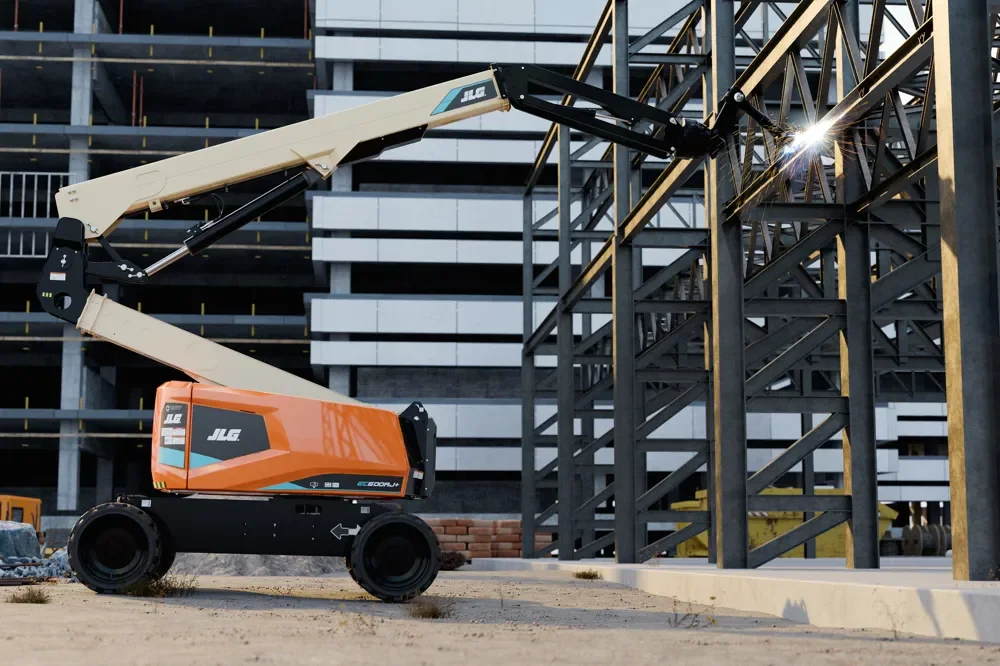
JLG showed a boom lift with a robotic arm that welds at height. It won a Best of Innovation award at CES 2026 and appeared again at CONEXPO doing live welds while one operator supervised several machines. It is an impressive demonstration.
It is also, in JLG’s own words, a concept machine. There is no price, no spec sheet, no order book, and no stated availability date. Understanding the difference between that and a product matters, because the equipment press has not always drawn the line clearly.
What was actually shown
The base machine is real. The EC600AJ is a production electric articulated boom lift with 60 feet of platform height, 36 feet of horizontal reach, and 550 pounds of unrestricted capacity, launched separately at World of Concrete.
The robotic version adds robotic manipulators, AI guided control, and multi sensor perception, with the stated ability to weld, inspect, and install, and to interface with digital twins and jobsite management platforms. Equipment World described it plainly as a concept vehicle. The design intent JLG has articulated is moving the worker off the platform and onto the ground as a supervisor and technician.
At CONEXPO in February 2026, JLG ran a coordinated demonstration: two scissor lifts moving and positioning structural material plus a boom lift performing welds at height, coordinated over its ClearSky Smart Fleet platform with one operator overseeing multiple machines. Reported as supervised coordination, not full autonomy. A micro scissor lift with leader follower control was shown alongside it.
What has not been published: any price, any autonomy level, any commercial launch date, and any third party validation of the weld quality the arm produces. For a welding application, that last one is the number that matters.
The corporate context, and a correction
In January 2026 JLG announced it was taking on the drywall finishing robotics developed by Canvas. The precise wording matters and is frequently reported loosely, including in earlier coverage on this site: JLG acquired the core technology developed by Canvas Construction, not the company itself. Terms were not disclosed and Oshkosh declined to provide financials.
The most revealing document is the parent company filing. Oshkosh Corporation’s fiscal 2025 Form 10-K does not mention Canvas anywhere. The Access segment technology narrative centers on ClearSky Smart Fleet, the AG619 telehandler, and the micro scissor lift, and the concrete autonomy program named in the filing is the military Family of Multi-Mission Autonomous Vehicles rather than construction robotics. Company wide research and development spending was $174 million in 2025, with the Access segment representing 43 percent of consolidated net sales.
On the first quarter fiscal 2026 earnings call in May 2026, management said Canvas drywall robotics and the robotic welding end effector both generated strong customer interest, and the chief executive called Canvas an important part of JLG’s autonomy strategy. No revenue expectations and no commercialization dates were given for either. The Canvas machine shown at CONEXPO was labeled a preview model and is not yet purchasable.
Read that as a company placing early bets rather than shipping products. The acquisition was small enough not to warrant 10-K disclosure.
The safety data, and why it is weaker than you would expect
If the argument for robots at height is safety, the evidence base deserves scrutiny.
Current national numbers are solid. BLS recorded 5,070 fatal work injuries in 2024 at a rate of 3.3 per 100,000 full time equivalents, down 4 percent from 2023. Construction and extraction occupations accounted for 1,032 fatalities. Fatal falls, slips, and trips totaled 844, with 370 among construction and extraction workers, down 7.5 percent year over year.
Aerial lift specific data is the problem. The figure the industry still cites, 26 construction workers killed per year by aerial lifts and 2 to 3 percent of all construction deaths, comes from CPWR analysis of 207 deaths between 1992 and 1999. That breakdown, 69 electrocutions, 64 falls, 46 collapses or tipovers, with boom supported lifts accounting for 68 percent, is genuinely useful. It is also more than a quarter century old, and no current equivalent exists.
The same caution applies to scaffold numbers. OSHA’s widely quoted figures of 9,750 scaffold related injuries and at least 79 scaffold associated fatalities annually come from the economic analysis of the 1996 final rule.
The best current dataset is IPAF’s Global Safety Report, which recorded 100 MEWP fatalities worldwide in 2024, down from 135 in 2023, drawn from 170 incident reports across 26 countries. Overturn remains the most common cause. Worth reading with one caveat: IPAF data is voluntarily self reported by members through a portal rather than a census, so year over year swings may reflect reporting behavior as much as incident rates.
ANSI A92, which changed more than people realize
The 2020 revision of the aerial platform standards is the more consequential development for most fleets, and some contractors still have not fully absorbed it.
The standards are ANSI/SAIA A92.20 for design, A92.22 for safe use, and A92.24 for training, with the Scaffold and Access Industry Association as secretariat. The original December 2019 effective date slipped after ANSI partially upheld two appeals, and the final versions took effect June 1, 2020.
| Area | What changed |
|---|---|
| Terminology | Aerial Work Platforms became Mobile Elevating Work Platforms, harmonizing with ISO and CSA, with new Group A/B and Type 1/2/3 classifications |
| Design | Load sensing that alarms and inhibits operation over capacity, tilt sensing that inhibits movement, entrance gates with toe guards replacing chains, guardrail height raised from 39 to 43.5 inches, solid or foam filled tires for rough terrain |
| Safe use | Written site and equipment specific rescue plan now required, plus a formal risk assessment |
| Training | Supervisors must be trained, not just operators. Occupants, meaning anyone in the platform who is not the operator, must be trained. Maintenance technicians must be trained on the new sensing systems |
The supervisor training and written rescue plan requirements are the two that most often catch fleets out, and neither existed before this revision.
Robotic welding and the labor numbers
Robotic welding is mature in the shop and essentially absent in the field. Novarc’s spool welding robot for pipe fabrication is a shipping commercial product, though all published productivity figures for it are vendor sourced.
The broader robot market is growing steadily. The Association for Advancing Automation reported 36,766 North American robot orders worth $2.25 billion in 2025, up 6.6 percent in units, with general industry rather than automotive driving growth. Note that A3 does not report construction as an industry segment at all, so any claim about robotic welding units sold into construction cannot be verified from public data.
On the welder shortage, two numbers circulate and they count different things. The American Welding Society reports 771,000 welding professionals in the United States as of 2024, 157,000 nearing retirement, and 320,500 new welders needed by 2029. BLS counts the specific occupation of welders, cutters, solderers, and brazers at 457,300 employed in 2024, projects 2 percent growth through 2034 against a 3 percent all occupation average, and expects about 45,600 annual openings, mostly from replacement rather than growth, at a median wage of $51,000.
Both can be true because they measure different populations. The figure to avoid is the widely repeated 360,000 shortage by 2027, which does not appear in the AWS material. The defensible reading is that this is a retirement and attrition problem rather than a demand growth problem.
What independent evidence exists on robots at height
Very little, and that is worth stating directly.
The only peer reviewed work locatable on this specific question is a 2025 paper in Systems examining human robot collaboration safety in high rise construction. Its method is a structural equation model built on a survey of 84 projects, which captures perception and intention rather than measured injury or productivity outcomes. Its finding, that human centered alignment matters more than task to robot alignment, is interesting but not a performance measurement.
No independent field study, no insurance loss data, and no OSHA or NIOSH evaluation of robotic work at height could be found. Every productivity and safety number attached to this category today originates with a manufacturer.
That does not make the technology a bad idea. Moving a welder off a platform 60 feet up is intuitively attractive, and electrocution and falls dominate the historical aerial lift fatality data. It does mean that anyone building a business case right now is working from vendor material, and should treat a live demonstration as a demonstration.
Sources
JLG, CES 2026 Innovation Award, November 2025
Equipment World, JLG robotic articulated boom lift concept
JLG, CONEXPO robotics demonstration, February 2026
JLG, acquisition of core technology developed by Canvas, January 2026
Oshkosh Corporation Form 10-K, fiscal year 2025
BLS Census of Fatal Occupational Injuries, 2024
CPWR, deaths from aerial lifts, BLS data 1992 to 1999
IPAF Global Safety Report 2025
Lift and Access, ANSI A92 standards effective June 2020
IPAF user guidance on the ANSI A92 standards
A3, North American robot orders 2025
American Welding Society, Where Are the Welders, October 2025
BLS Occupational Outlook Handbook, welders
Lin et al., human robot collaboration safety in high rise construction, Systems, November 2025
Keep reading
The Canvas drywall robot: what it does and does not do
Safety helmets and smart PPE: evidence versus marketing
Construction exoskeletons: what the evidence shows
