
Autonomous Staking Robots and the Licensing Question
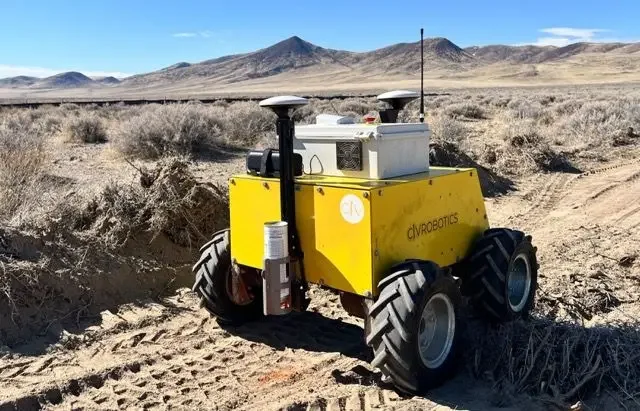
If you’ve ever driven past a construction site in the early stages, you’ve likely seen them: the surveyors. They’re usually lugging heavy tripods, fighting through mud, and hammering thousands of wooden stakes into the ground under a blazing sun. It is essential work, nothing gets built without layout, but it is also back-breaking, slow, and prone to human error.
Enter CIV Robotics, a company that looked at that muddy, exhausting process and asked: "Why can't a robot do the walking?"
As we move deeper into 2026, the construction industry is facing a massive crossroads. We have a shortage of skilled labor and an unprecedented demand for renewable energy infrastructure. Here is why CIV Robotics is becoming a critical player in this new landscape and what it tells us about the future of building.
Meet the CivDot: The Rover with a Paint Can
At its core, CIV Robotics solves a simple but massive problem: Layout.
Before a solar farm can be installed or a foundation poured, someone has to mark the exact coordinates on the ground. Traditionally, a human crew might mark 300 to 400 points a day.
CIV’s flagship solution, the CivDot (and its high-precision sibling, the CivDot+), is an autonomous rover that acts like a Roomba for construction sites, if a Roomba were rugged, waterproof, and equipped with high-precision GPS.
Instead of vacuuming, it drives to a coordinate, validates its position with millimeter-level accuracy, and uses an onboard spray-paint mechanism to mark the spot. The result? 1,000 to 5,000 points per day. That is roughly 8x faster than a human crew, with zero back pain.
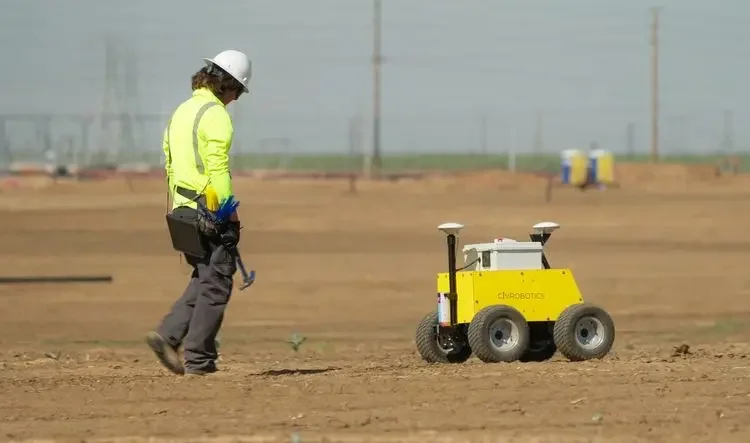
Why This Tech Matters Now
It’s easy to get excited about robots just because they’re cool, but CIV Robotics is gaining traction (recently securing major funding and partnerships with industry giants like Trimble and Bobcat) because they address three critical pain points:
Utility scale solar has an unglamorous bottleneck. Before a single pile goes in the ground, somebody has to mark hundreds of thousands of points across a few thousand acres. On the Edwards and Sanborn project in California, roughly 400,000 piles needed staking.
That is the problem autonomous staking robots were built for, and it is the one place in construction where this category has a clear business case. It also raises a licensing question the vendors do not address, which is worth understanding before you put one on a job.
What the machines are
Civ Robotics, founded 2018 in San Francisco, builds a four wheel drive rover that drives a coordinate file and sprays marks on the ground. The current lineup and its published accuracy:
| Model | Accuracy claim | Basis |
|---|---|---|
| CivDot | 1/10 ft, about 30 mm | GNSS RTK |
| CivDot Plus | 3/100 ft, about 8 mm | Dual RTK plus IMU |
| CivDot Mini | Sub inch, about 2 cm | Line marking, up to 17 miles per day |
The hardware is a rover with 10 inches of ground clearance, an 8 hour battery, spray paint marking rather than wooden stakes, and remote operation to about 100 feet. It is deliberately vendor agnostic on positioning, working with Trimble, Topcon, Leica, and NTRIP or VRS networks.
Published pricing, which is unusual in this category and worth crediting: CivDot from $60,000, CivDot Mini at $40,000, and the newer CivNav machine guidance product at $3,000 per month.
On the throughput numbers
Civ’s own materials conflict. The CivDot Plus product page says up to 1,200 points daily. The company FAQ and its Series A announcement say up to 3,000 points per day. The one figure tied to a named project, a Bechtel case study, reports about 1,250 coordinates per day at 125 points per hour against 25 per hour manual.
Read 3,000 as a ceiling under ideal conditions rather than a field rate. The 1,250 figure, at the low end of the company’s own range, is the one with a project attached to it.
The strongest independent corroboration is not a statistic but an attribution. Bechtel’s principal vice president for US renewables is on record in ENR saying the technology improved survey time sixfold across four solar facilities totaling more than 200 MW. That is a named executive at a top tier contractor in a trade publication, a meaningfully higher standard of evidence than a vendor case study.
The licensing question nobody is answering
Civ’s FAQ states that the CivDot can be operated by anyone, with no special license or skill set required. That is true about the machine and misleading about the work.
The controlling concept in surveying law is responsible charge. A licensee must supervise, and the coordinate control the robot consumes is itself professional work product. California is the clearest jurisdiction on this. Business and Professions Code section 8726 defines the practice of land surveying to include one who locates, relocates, establishes, reestablishes, or retraces the alignment or elevation for fixed works, which is construction staking described verbatim. The same section captures performing surveys that determine horizontal or vertical positions of fixed objects, which describes GNSS positioning directly.
The Caltrans Surveys Manual puts it plainly: construction stakes must be set under the responsible charge of a licensed land surveyor or civil engineer, and stakes referenced to California Coordinate System coordinates must be set under the responsible charge of a person authorized to practice land surveying in the state. A robot working from a coordinate file off an RTK base is doing exactly that.
Treatment varies widely by state, and most statutes are silent on construction layout that does not touch boundaries. Boundary work universally requires a license. The honest summary is that a licensee establishes and certifies the control network and the coordinate file and carries the liability, while unlicensed crews, or a robot, execute the physical marking.
That framing also explains the economics better than the marketing does. The robot substitutes for the technician, not for the licensee. Bureau of Labor Statistics data puts surveying and mapping technicians at 59,400 jobs with median pay of $51,940, against 56,100 licensed surveyors at $72,740. The machine displaces the first number.
One genuine gap worth flagging: no position statement from the National Society of Professional Surveyors and no ruling or advisory opinion from any state licensing board specifically addressing robotic or autonomous staking could be located. The regulatory framework has not caught up to the equipment.
Is there really a surveyor shortage
Yes, but not for the reason usually given, and the BLS numbers do not show it.
BLS projects 4 percent growth for surveyors and 5 percent for surveying technicians through 2034, both unremarkable, with most openings coming from replacement rather than new demand. Nothing there says shortage.
The demographic data is a different story. An NSPS survey of roughly 2,409 respondents found 31.3 percent aged 51 to 60, 23.5 percent aged 61 to 70, and 4.8 percent over 70, so nearly 60 percent are over 50. Only 1.45 percent were aged 21 to 30. The most striking figure is that 63 percent reported having no employees on the path to licensure.
That is the real constraint. Not demand growth, but an empty pipeline into a licensed profession where roughly six in ten practitioners are within fifteen years of retirement.
Where the category is heading
Civ raised a $7.5 million Series A in July 2025 led by AlleyCorp with Bobcat participating, bringing total funding to $12.5 million, and stated it reached profitability that year with more than 100 robots deployed. One correction worth making: Trimble did not acquire Civ Robotics. Trimble Ventures made a minority investment in September 2022, and the company remains independent.
The more interesting competitive threat is not another staking robot. Built Robotics sells an autonomous pile driver, the RPD 35, that combines surveying, pile distribution, pile driving, and data collection in one machine. If you can drive the pile straight from the model, you never stake at all. Blattner, one of the largest US solar contractors, has adopted them.
Indoor layout robots such as the Dusty Robotics FieldPrinter and HP SitePrint are a different market entirely, working from BIM models on interior slabs rather than staking open ground.
What to ask before you deploy one
Who is in responsible charge of the control network and the coordinate file, and are they licensed in the state where the work is happening. That question needs a name on the answer.
What accuracy does the specification actually require. There is an order of magnitude between the 30 mm base model and the 8 mm dual RTK version, and solar pile tolerance is not structural layout tolerance.
What is the realistic daily rate on your terrain rather than the marketing ceiling. Ask for a named project reference at similar scale.
Run your own cost math. No credible cost per stake figure exists from any source, so build it from the $60,000 capital cost against your own crew day rate rather than trusting a brochure number.
Sources
Civ Robotics FAQ and specifications
Civ Robotics published pricing
ENR, Civ Robotics Series A and Bechtel comment, July 2025
Trimble Ventures minority investment, September 2022
Caltrans Surveys Manual, Chapter 12, Construction Surveys
California Business and Professions Code section 8726
NSPS Surveying Profession Demographics survey
BLS Occupational Outlook Handbook, surveyors
BLS Occupational Outlook Handbook, surveying and mapping technicians
Built Robotics RPD 35 autonomous pile driver
The Robot Report, CivNav launch, December 2025
Keep reading
HP SitePrint cost, specs, and jobsite results
Dusty Robotics FieldPrinter: BIM layout on the slab
Rugged Robotics and jobsite ready robots