
Construction Safety Week: Three Critical Rules That Save Lives
Construction remains one of America's most hazardous industries. In 2024, there were 389 fatal falls to a lower level out of 1,034 construction fatalities, according to the Bureau of Labor Statistics. These deaths were preventable. During this Safety Week, we're focusing on three fundamental safety practices every construction worker must follow to make it home safely. Occupational Safety and Health Administration
1. Never Trust Loose Plywood Laid on Floors
One of construction's most deceptive hazards hides in plain sight: loose plywood sheets lying on subfloors. These sheets almost always cover floor openings, mechanical chases, stairwells, or holes for future work. The danger is that they look identical to actual flooring until you step on them.
Why This Matters
Falls from elevation continue to be a leading cause of death for construction employees, according to OSHA's National Safety Stand-Down program. OSHA's National Emphasis Program on Falls saw fatal falls investigated by federal OSHA drop from 234 to 189 between fiscal years 2023 and 2024, demonstrating that focused attention on fall hazards saves lives. Occupational Safety and Health AdministrationOccupational Safety and Health Administration
Floor openings covered by unsecured plywood create a fall-through hazard that can result in serious injury or death. When these sheets shift, tip, or break under weight, workers can fall to the level below, often with the plywood following them down.
What to Look For
Plywood sheets with no visible fasteners or nails
Sheets sitting flush on the floor but not secured
Any wobble, gap, or movement when you walk near the area
Random sheets in high-traffic areas or near mechanical work
The Simple Rule
Walk around any loose plywood you didn't personally place and secure. Taking an extra 10 seconds to go around a suspicious sheet is always safer than assuming it's structural. If you're unsure whether plywood is secured, treat it as a hazard and report it to your supervisor.
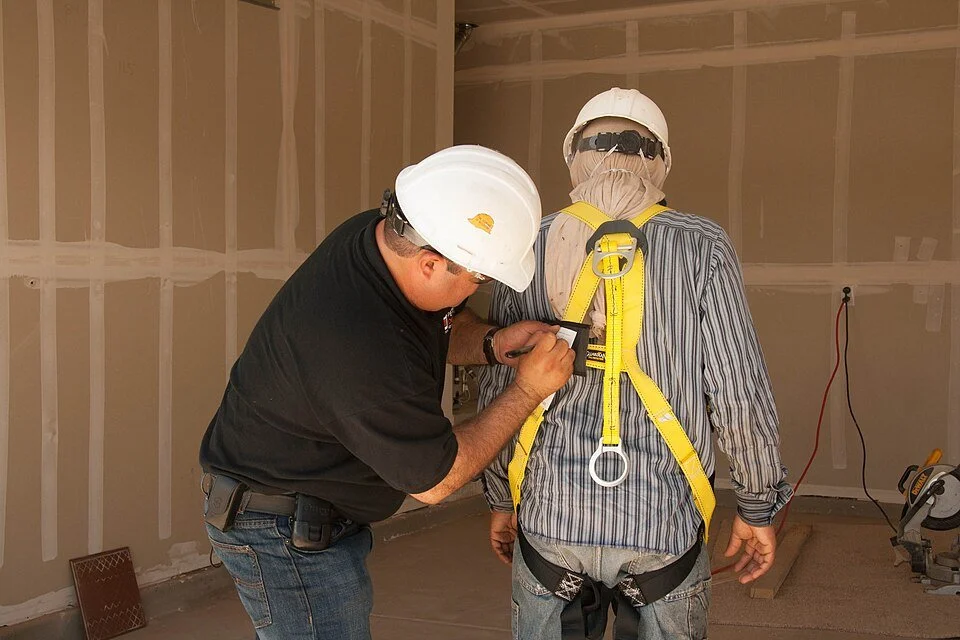
A construction worker wearing a fall arrest system harness
OSHA Requirements: Fall protection standards (29 CFR 1926.501) require employers to protect workers from falls through holes and openings. Fall Protection general requirements topped OSHA's list of most frequently cited standards in fiscal year 2024. Occupational Safety and Health Administration
2. Safety Glasses Are Not Optional
Eye injuries remain among the most common and preventable construction injuries. Thousands of people are blinded each year from work-related eye injuries that could have been prevented with the proper selection and use of eye and face protection, according to OSHA's Eye and Face Protection guidelines. Occupational Safety and Health Administration
The Statistics Are Clear
The U.S. Bureau of Labor Statistics estimates nearly 20,000 workplace eye injuries occur yearly. Nearly three out of every five workers injured were not wearing eye protection at the time of the accident. Even more concerning, approximately 40% of injured workers who were wearing some form of eye protection had the wrong type for their task. CompliancetrainingonlineeLCOSH
Construction workers face constant eye hazards:
Flying debris from cutting, drilling, and grinding
Wood chips and metal shavings
Concrete dust and drywall particles
Ricochet from power tools
Chemical splashes
Nail gun misfires
When Protection Is Required
Safety glasses must be worn whenever:
Operating power tools or equipment
Cutting, drilling, grinding, or chipping materials
Working in areas where others are using tools
Sweeping or cleaning near active work areas
Handling chemicals or mixing compounds
"I'm just doing this quick thing" is exactly when injuries happen. Almost 70 percent of eye injury accidents resulted from flying or falling objects or sparks striking the eye, with nearly three-fifths of the objects estimated to be smaller than a pinhead. eLCOSH
OSHA Standards
Construction employers must comply with 29 CFR 1926.102, which mandates appropriate eye and face protection when workers are exposed to hazards from flying particles, molten metal, liquid chemicals, acids, caustic liquids, chemical gases or vapors, or potentially injurious light radiation.
In 2023, OSHA issued 2,074 violations for eye and face protection, making it the ninth most frequently cited standard. Protective eyewear can prevent more than 90 percent of serious eye injuries when properly selected and used. VelocityEHSeLCOSH
3. Call 911 First in a Medical Emergency
In a serious medical emergency, every second counts. Yet many workers instinctively reach for their radio to call their supervisor before dialing 911. This delay can be fatal.
When to Call 911 Immediately
Contact emergency services first if someone is:
Not breathing or struggling to breathe
Unconscious or unresponsive
Experiencing heavy bleeding that won't stop
Having chest pain or signs of heart attack
Showing signs of stroke
Injured from a fall from height
Trapped or caught in equipment
Severely burned
Suffering from heat stroke
Experiencing an allergic reaction or anaphylaxis
Why This Order Matters
Professional emergency medical responders can provide life-saving care that coworkers cannot. Paramedics carry advanced equipment and medications, and emergency dispatchers can provide critical instructions while help is on the way.
OSHA's Emergency Action Plan requirements (29 CFR 1910.38) require employers to establish procedures for reporting emergencies. Dialing 911 is a common method for reporting emergencies, and emergency situations must be immediately reported as fires and other emergency situations can reach dangerous levels in seconds. Occupational Safety and Health Administration
The Correct Response Sequence
Call 911 immediately if the situation is life-threatening
Provide first aid if you're trained (while waiting for EMS)
Notify your supervisor after emergency services are dispatched
Secure the scene to prevent additional injuries
Guide emergency responders to the injured worker when they arrive
OSHA does not issue citations to employers if a policy recommends that employees call 911 in emergency situations, provided such a policy does not discourage the rendering of first aid by trained employees. Occupational Safety and Health Administration
First Aid Is a Bridge, Not a Replacement
While calling 911 is critical, having trained first-aid responders on site is also required. The purpose of first aid is to give injured employees some level of medical attention as quickly as possible to bridge the gap between the accident and full medical treatment. Under 29 CFR 1910.151, employers must ensure that personnel are adequately trained to render first aid when medical facilities are not in near proximity to the workplace. Occupational Safety and Health Administration
Employer Responsibilities
Employers must:
Provide comprehensive safety training
Ensure proper safety equipment is available and maintained
Establish clear emergency response procedures
Post emergency contact numbers prominently
Conduct regular safety meetings and toolbox talks
Maintain OSHA-compliant first aid kits
Document all training and incidents
OSHA Reporting Requirements: Employers must report all work-related fatalities to OSHA within 8 hours and all work-related in-patient hospitalizations, amputations, or losses of an eye within 24 hours by calling 1-800-321-OSHA (6742).
The Bottom Line
These three safety rules are not suggestions. They are the minimum standard for staying alive on a construction site:
Walk around loose plywood - it's covering something dangerous
Wear safety glasses - your eyes don't heal like your hands
Call 911 first - every second matters in an emergency
Safety Week is a reminder, but these practices apply every single day. Construction work is demanding and deadline-driven, but no schedule is worth a life-changing injury or death.
If you see something unsafe, speak up. If you're not sure about a procedure, ask. If conditions are dangerous, stop work. The job will still be there after we address the hazard. Your health and your life won't wait.
Additional Resources
OSHA's Free On-Site Consultation Program: 1-800-321-6742
This article has been reviewed for accuracy against current OSHA standards and Bureau of Labor Statistics data as of May 2026. All statistics and regulatory requirements are properly cited to authoritative government sources. For the most current safety information, always consult OSHA.gov or contact OSHA directly at 1-800-321-OSHA (6742).
About Dimecraft: Dimecraft is building the next generation of construction technology to help contractors work safer, faster, and smarter. Our mobile-first takeoff and estimating platform empowers field teams with the tools they need to succeed.
Keep reading
How to do a construction takeoff on iPad
Hilti’s Exoskeleton Tech Brings Wearable Devices to the Trades
Armet Pro Smart Helmet Brings Connected Safety to Jobsites