
Construction Exoskeletons: What the Evidence Actually Shows
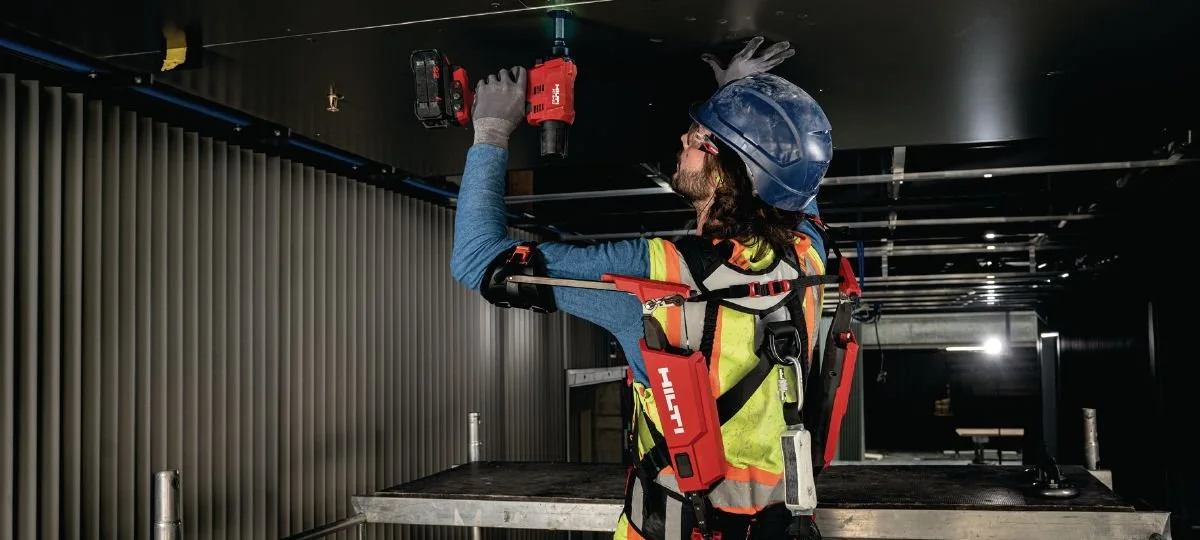
Wearable exoskeletons have moved from trade show curiosity to a line item some contractors are actually budgeting. Hilti sells three of them. The question worth answering is not whether they work in a marketing video, but whether the independent evidence supports buying them, and for which crews.
The short version: the lab evidence for sustained overhead work is real and measurable. The field evidence is mixed, and in one case from the National Institute for Occupational Safety and Health, actively negative. The financial case is strongest for older crews doing static overhead work at ground level.
What Hilti actually sells
| Model | Type | Weight | Price |
|---|---|---|---|
| EXO-S (shoulder, second generation) | Passive, no motors or batteries | 2.4 kg (5.3 lb) | $1,669 standard, $1,749 large |
| EXO-O1 (overhead, first generation) | Passive | Under 2 kg (4.4 lb) | Launched 2021 at $1,599 or $60 per month |
| EXO-T-22 | Active wearable tool balancer | Under 8 kg (17.6 lb) | From $2,149 |
The EXO-T-22 is a different category and should not be lumped in with the others. It carries the weight of the tool, not the weight of your arms, and supports loads up to 37.5 lb. The EXO-S and EXO-O1 are passive shoulder supports that transfer arm weight to the hips through a mechanical cable and pulley system. They were developed with Ottobock, the German prosthetics manufacturer, under a partnership announced in July 2020.
Two practical limits worth knowing before purchase. The EXO-O1 is not flame retardant and is unsuitable for welding. The EXO-S list price has risen roughly 19 percent since its 2023 launch, from about $1,400 to $1,669.
The 47 percent claim, and where it comes from
Nearly every article about Hilti exoskeletons repeats that the device reduces peak shoulder load by up to 47 percent. That number deserves scrutiny. Ottobock’s press release attributes it to “independent studies” without naming a study, an institution, an author, or a publication. Hilti’s own materials state it without attribution. Equipment World traced it to a Hilti project manager describing internal observations of workers who spend 50 to 60 percent of their time overhead.
No peer reviewed paper behind it could be located. Treat 47 percent as a manufacturer claim, and note its qualifiers: peak load, up to, and a narrow worker profile.
What independent research actually found
The strongest positive evidence comes from De Bock and colleagues, published in IEEE Transactions on Biomedical Engineering in 2022. In a randomized crossover trial with 22 participants across six simulated industrial tasks, a passive shoulder exoskeleton reduced anterior deltoid muscle activity by up to 16 percent and muscle fatigue by up to 41 percent. Two caveats matter enormously for a contractor deciding what to buy. Those gains occurred during isometric, meaning static, overhead work. The effect was notably smaller during dynamic tasks, and the authors described the assistive profile as potentially sub-optimal for dynamic work. The exoskeleton also increased user frustration and discomfort at contact points.
NIOSH ran its own testing and the results were less encouraging. In a 2024 study published in the International Journal of Industrial Ergonomics, seven participants lifted 35 lb cinder blocks on a simulated mast climber while wearing three different shoulder-assist exoskeletons. Only one of the three significantly reduced activity in any particular shoulder muscle. Two of the three significantly increased center of pressure sway, meaning they measurably degraded balance. One also increased sway velocity.
A 2023 field study in the journal Buildings tested actual Hilti hardware, the EXO-001, along with the Ekso EVO and a HeroWear back exosuit, on four professional construction workers. Both arm support devices restricted shoulder range of motion, particularly for movements close to the body. Exoskeleton use increased heart rate during gondola pushing. Workers reported movement restraints and pain and soreness from tightened straps. The sample was four men at a prep yard, so treat it as indicative rather than definitive.
Equipment World’s hands-on review of the EXO-S is the most useful contrarian source available. The reviewer found the device required more than seven minutes of adjustment per user, making sharing across a crew impractical, ran hot without air conditioning, worked mainly at full arm extension while the user fought the suit at intermediate angles, and could not fully carry a 30 lb drill even at maximum support.
The point safety managers should not miss
NIOSH classifies exoskeletons as personal protective equipment, which places them at the bottom of the hierarchy of controls. The agency states the preferred approach is redesigning the work to mitigate risk through engineering controls or process change. NIOSH has also drawn an explicit comparison to back belts, which the agency ultimately found had insufficient evidence of effectiveness in preventing injury.
That classification has real consequences for how a program is documented and defended. An exoskeleton program does not substitute for engineering controls, and framing it that way in a written safety plan invites a problem later.
NIOSH has also catalogued specific hazards: increased chest pressure, a genuine concern for workers with COPD, impaired ability to dodge falling objects, documented findings that human recovery strategy following a collision was negatively impacted by exoskeleton use, pressure wounds and compressed nerves from poor fit, and infectious disease transmission through shared devices. The Canadian Centre for Occupational Health and Safety adds that upper body exoskeletons may strain the back during bending tasks, and that force redistribution may transfer strain to other body regions.
The problem these devices are aimed at
The underlying injury data is well documented and worth knowing regardless of what you decide about exoskeletons. According to CPWR analysis of Bureau of Labor Statistics data, 33,200 construction workers had musculoskeletal disorders resulting in days away from work in 2021 and 2022, a rate of 19.4 per 10,000 full time equivalents. That rate has actually fallen 42.8 percent since 2011.
The distribution matters more than the total. Specialty trade contractors carry the highest rate at 28.4 per 10,000, with 25,000 cases, precisely the trades doing overhead work. By body part, the back accounts for 41.7 percent of construction musculoskeletal disorders and the shoulder 20.9 percent. By occupation, construction helpers run 89.7 per 10,000 and sheet metal workers 80.1. Median days away from work in construction is 15 days.
The financial argument is sharper than most vendor material makes it. A CDC study of 10,347 accepted Ohio workers compensation claims for overexertion related musculoskeletal disorders found cost per claim rises steeply with age: $25,932 for workers aged 45 to 54, against $3,492 for workers aged 18 to 24. One avoided claim in the older bracket covers roughly fifteen devices at $1,669.
Where the evidence supports use, and where it does not
| Reasonable | Caution or avoid |
|---|---|
| Sustained static overhead work: ceiling drywall, overhead grinding, hanging duct, sprinkler, and conduit | Elevated or unstable surfaces. NIOSH found two of three devices increased postural sway on a simulated mast climber |
| Older crews, where cost per claim is roughly seven times that of the youngest workers | Work where dodging falling objects matters, given documented impairment of collision recovery |
| Dedicated assignment to one worker, given seven plus minutes of fit adjustment | Welding and hot work. The EXO-O1 is not flame retardant |
| Plumbers, electricians, and carpenters for passive devices, per CPWR funded research | Ground level lifting with an upper body device, which may increase back strain |
| Dynamic work where arm position changes constantly, since measured benefit drops | Workers with respiratory conditions, given increased chest pressure |
If you are running a pilot
One finding should shape how you evaluate. A 2025 Virginia Tech study found that safety concerns raised in interviews contrasted with positive responses during field testing, where workers wore devices for up to one hour. Assessment conditions bias feedback. Heat buildup, strap soreness, and adjustment fatigue are precisely the problems that only surface across a full shift or a full week. A one hour demo will make any exoskeleton look better than it is.
Research funded by CPWR through NIOSH identified fifteen barriers to adoption. The three cited most often by construction experts were the cost of lightweight materials at 81 percent, limited worker training resources at 86 percent, and data protection regulation complexity at 86 percent. A separate survey of 361 construction stakeholders found perceived barriers differ significantly by race, sex, and age, which raises a real question about proportionate access within a crew.
Worth noting for anyone writing procurement specifications: ASTM Committee F48 on Exoskeletons and Exosuits is the active standards body, but no dedicated exoskeleton safety standard yet exists. That gap is itself a documented barrier to the industry.
Sources
NIOSH Science Bulletin, exoskeletons in construction workplaces, February 3, 2022
NIOSH Science Blog, will exoskeletons reduce or create hazards, June 2017
NIOSH, wearable exoskeletons and the hierarchy of controls, March 2016
NIOSH, shoulder-assist exoskeleton effects on balance during block laying, 2024
De Bock et al., IEEE Transactions on Biomedical Engineering, 2022
Zhu et al., field testing of passive exoskeletons, Buildings, March 2023
CPWR Data Bulletin, musculoskeletal disorders in construction, June 2025
CDC MMWR, workers compensation claim rates and costs, Ohio, April 2021
CPWR and Georgia Tech, ethical and social risks of exoskeletons, March 2025
Equipment World, hands-on review of the Hilti EXO-S
Canadian Centre for Occupational Health and Safety, exoskeleton hazards
Real-world adoption of exoskeletons in construction, Construction Robotics, January 2026
Keep reading
Construction safety: floor openings and loose plywood
Smart helmets and connected jobsite safety
Robotic drywall finishing and the silica problem