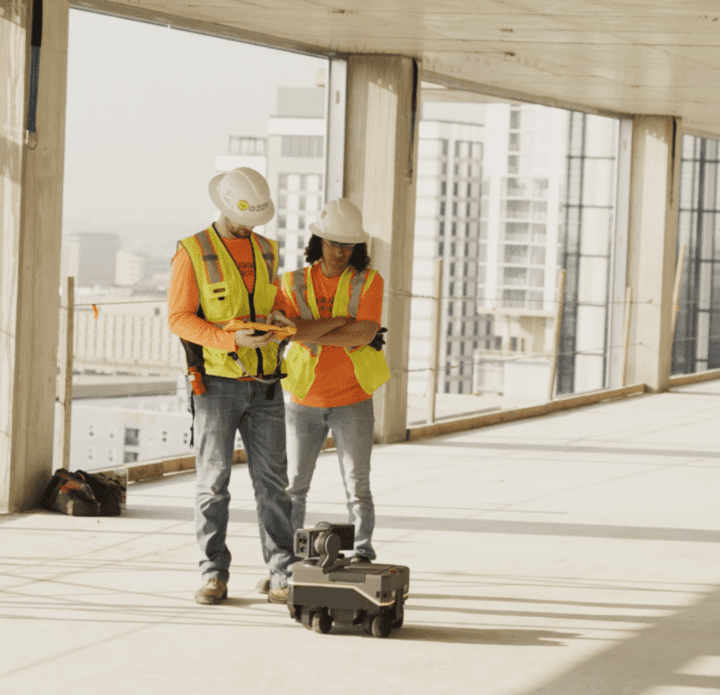
Built Tough: Rugged Robotics and the Rise of Jobsite-Ready Robots
For decades, the construction industry has looked over the fence at manufacturing with a mix of envy and skepticism. We watched automotive plants deploy sleek automated lines and logistics centers run like clockwork with swarms of robots. But any superintendent knows why those machines stayed indoors: a construction site is not a factory.
Factories have flat, polished floors, consistent lighting, and roofs.
Construction sites have mud up to your ankles, silica dust hanging in the air, open elevator shafts, and topography that changes every afternoon. For a long time, the technology simply wasn't tough enough to survive outside the wire.
That is changing. We have officially entered the era of the "rugged robot." These aren't the delicate prototypes of ten years ago; they are hardened, mud-loving tools designed to handle the brutality of the jobsite. As the technology matures, the next five years will fundamentally shift how General Contractors and trade partners handle the dull, dirty, and dangerous work.
What Makes a Robot Rugged?
To survive a typical Tuesday on a commercial project, a robot needs more than just a thick metal casing. The shift from "lab toy" to "jobsite tool" required three specific leaps in technology.
First, the hardware had to get wet. We are finally seeing industrial hardening with high Ingress Protection (IP) ratings, typically IP65 or higher. This means the new generation of machines, whether they are four-legged walkers like Boston Dynamics’ Spot or tracked crawlers, are dust-tight and can withstand heavy rain or accidental blasts from a hose. They feature shock-mounted electronics to handle the vibration of a jackhammer working ten feet away.
Second, the robot had to learn to see in the dark. GPS is notoriously unreliable indoors or next to high-rises, so rugged robots rely on SLAM (Simultaneous Localization and Mapping). To make this work in a dusty environment, engineers are using "sensor fusion." They combine data from 3D LiDAR, which fires laser pulses to map geometry through fog or darkness, with stereo cameras and internal gyroscopes. This allows the machine to know exactly where it is on the slab, even if a sheet of plywood blocks its view or the lights go out.
Finally, the brains had to move on board. Construction Wi-Fi is often spotty at best. A robot cannot rely on the cloud to decide if it’s about to step in a hole. The latest rugged tech utilizes Edge Computing, processing all that heavy mapping data locally on the machine. This allows for split-second decisions without lagging connectivity.
The Five-Year Outlook: 2025-2030
Right now, robots are in the pilot phase. You might see a robot dog taking photos on a mega-project, but it’s still a novelty to many. By 2030, however, these machines will likely be as common as laser scanners. Here is what the integration will look like in the next five years.
The most immediate change will be the autonomous "as-built" workflow. Currently, reality capture is a slow process that requires a VDC manager to walk the site with a tripod. In the near future, rugged bots will run the night shift. While the crew sleeps, autonomous rovers will navigate the active decks, performing high-fidelity LiDAR scans and taking 360-degree photos. By the time the superintendent pours their morning coffee, the bot will have docked and the software will have already compared the reality against the BIM model, flagging a conduit installed six inches off-spec before the concrete is even poured.
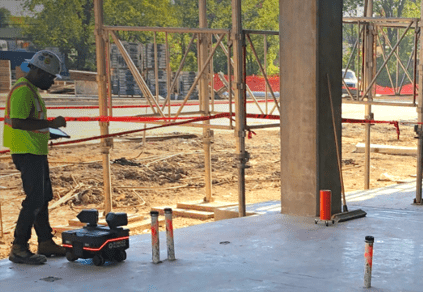
We will also see the automation of layout. Manual layout is time-consuming and prone to human error. We are already seeing ruggedized printers that paint lines on concrete, but the next evolution will combine these with total station technology. Robots will navigate the slab, marking out wall locations and hangers with digital precision, freeing up skilled carpenters to focus on building rather than snapping chalk lines.
Material movement is the third frontier. The industry is bleeding labor hours on logistics, moving drywall or fittings from the laydown yard to the specific zone on the 12th floor. We can expect to see heavy-payload autonomous tugs taking over this "last mile" delivery. A foreman will be able to order materials via a tablet, and a rugged rover will fetch the pallet, navigate the hoist, and deliver it to the work zone without a human operator.
The Human Element
There is often fear that robotics means replacing workers, but in construction, the math suggests otherwise. We are facing a chronic skilled labor shortage. The goal of the rugged robot revolution isn't to take the hammer out of a carpenter's hand; it is to stop them from wasting hours hauling trash or scanning rooms.
The robots are coming for the "Three Ds": the Dull, the Dirty, and the Dangerous. By 2030, if a job involves crawling into a hazardous confined space or walking a site for hours to scan it, a human probably won't be doing it. And that is a shift the industry should welcome.
Who Is Rugged Robotics?
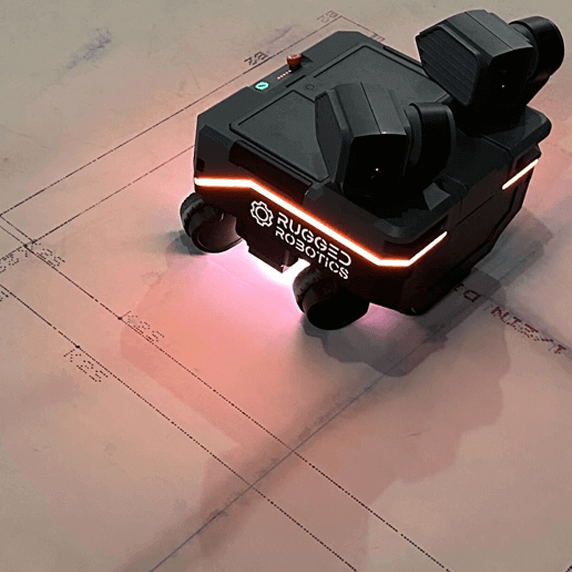
If you searched “rugged robotics” looking for the company rather than the category, here is the short version. Rugged Robotics is a US firm that sells automated field layout as a service: you send the BIM or CAD model, and their crew deploys a robot that prints precise, full-detail layout, not just control lines, directly on the slab, covering multiple trades in a single pass. There is no robot to buy or operate; it is a subcontracted scope. Clients include Hensel Phelps, Suffolk, Dematic, and data-center hyperscalers, and one published case study credits the service with freeing 750+ labor hours and accelerating framing installation by 15%, helping projects finish weeks ahead of schedule.
Layout Robots Compared: Rugged Robotics vs Dusty vs HP SitePrint
| Rugged Robotics | Dusty Robotics FieldPrinter | HP SitePrint | |
|---|---|---|---|
| What you buy | Layout as a service, their crew, their robot | Platform your team operates | Pay-per-use hardware you operate |
| What hits the floor | Full-detail, multi-trade drawings | Full BIM model with labels, tags, QR codes | Lines, arcs, points, and text from 2D CAD |
| Accuracy | Spec-grade, single-pass multi-trade | 1/16″ | ±3/32″ (2 mm) |
| Best fit | Outsource layout entirely | In-house VDC-to-field workflow | Lowest-commitment entry, per-job pricing |
Deeper dives: HP SitePrint cost and specs and Dusty Robotics on the jobsite.
FAQ: Rugged Robots and Rugged Robotics
What does Rugged Robotics do? It prints full-detail construction layout on the slab as a turnkey service, you submit the model, they mark the floor for every trade at once.
Do you buy the robot? No. Unlike HP SitePrint (pay-per-use hardware) or Dusty Robotics (a platform you run), Rugged Robotics is contracted like a sub.
What makes a robot “rugged”? IP65+ ingress protection, shock-mounted electronics, SLAM navigation with LiDAR sensor fusion, and on-board edge computing that works without jobsite Wi-Fi.
Will layout robots replace layout crews? The math points to reallocation, not replacement: robots absorb the dull, dirty, and dangerous hours while skilled workers shift to coordination, verification, and QC.
Whether the layout is printed by a robot or snapped by hand, the quantities behind it have to be right. Dimecraft is an iPad takeoff app for GCs, subs, and estimators, measure walls, counts, and areas directly off the PDF set. Try Dimecraft.
Keep reading
How to do a construction takeoff on iPad
Surveying the Future: CIV Robotics is Making its Mark
Canvas Construct Robot Performs Drywall Taping and Finishing.